
Descripción
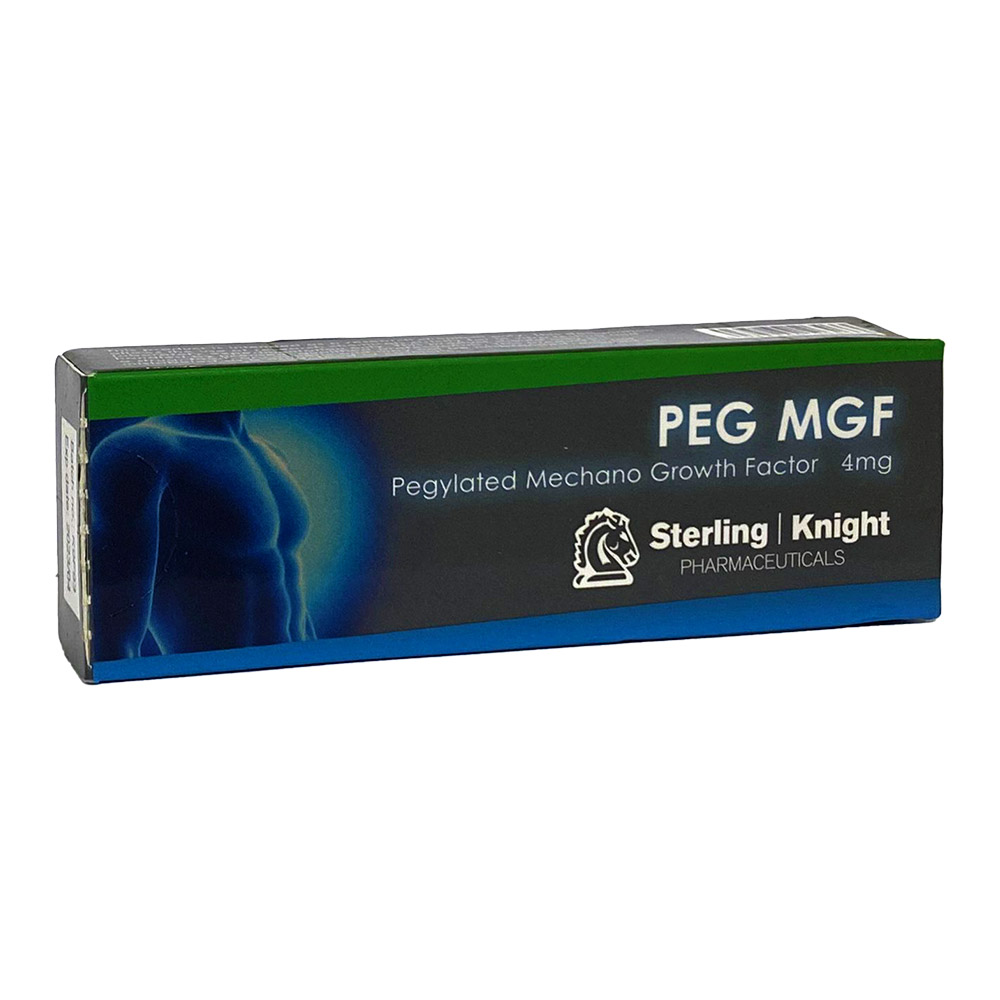
PEG-MGF 4 mg — Sterling Knight Pharmaceuticals
Category: Peptide / IGF-1Ec Analog (PEGylated)
Brand: Sterling Knight Pharmaceuticals
Strength: 4 mg lyophilised peptide
Form: Sterile vial for reconstitution
Packing: 1 × vial
Origin: United Kingdom
Price: €39
Research Use: Laboratory and analytical use only. Not for human or veterinary use.
🧬 What Is PEG-MGF?
PEG-MGF is a PEGylated analogue of Mechano Growth Factor (MGF), which is the E-domain splice variant of IGF-1Ec. Native MGF is short-lived in circulation; PEGylation significantly extends its duration, enabling researchers to study regeneration, repair, and mechanotransduction pathways with improved stability.
- Derived from the IGF-1Ec splice variant
- PEG-conjugation improves half-life and systemic exposure
- Useful in muscle-repair and satellite-cell activation models
- Supplied as a 4 mg lyophilised vial
🔬 Key Research Highlights
1. Biology & Origin
MGF (IGF-1Ec) is produced via alternative splicing of the IGF-1 gene and is typically upregulated following mechanical loading, muscle injury, and tissue damage. Its E-domain is biologically distinct from IGF-1Ea.
2. Preclinical Findings
Studies associate MGF E-peptide with:
- Satellite-cell activation
- Myoblast differentiation
- Regeneration signalling
Evidence varies — some studies support distinct activity, while others show limited effects for synthetic fragments.
3. Why PEGylate?
- Greatly increases peptide half-life
- Provides extended bioavailability
- Enables longer sampling windows in PK/PD studies
- Common technique for stabilizing otherwise short-lived peptides
4. Anti-Doping Relevance
MGF analogues, IGF-1 analogues, and growth-factor mimetics are banned under WADA S2.
📚 Research Applications
- Muscle-repair and regeneration signalling models
- Time-course experiments requiring prolonged peptide exposure
- Satellite-cell activation studies
- Anti-doping reference development for IGF/MGF-class agents
⚠️ Potential Side Effects & Class-Based Risks
As a growth-factor mimic, PEG-MGF may influence:
- Endocrine pathways
- Cellular proliferation/repair signalling
- Metabolic responses related to IGF-axis activation
Exposure may result in a positive WADA S2 doping test. Handle using appropriate biosafety precautions and personal protective equipment.
🛑 Compliance & Handling
- FOR RESEARCH USE ONLY — not for human consumption
- Not a dietary supplement or medical product
- Use only by trained laboratory personnel
- Follow institutional SOPs, SDS guidelines, and proper disposal
- WADA Category: S2 — Peptide hormones & growth factors
📊 Scientific Data Table
| Field | Data |
|---|---|
| Chemical Name | PEGylated Mechano Growth Factor (PEG-MGF), PEG conjugate of IGF-1Ec E-domain |
| Chemical Formula | Variable (PEGylated conjugates depend on PEG chain length) |
| Synonyms | PEG-MGF; PEG-IGF-1Ec; PEG-Mechano Growth Factor |
| Molecular Weight | Variable; commonly ~20–30 kDa depending on PEG size (confirm via COA) |
| CAS Number | No universal CAS; depends on manufacturer and PEG length |
| Scientific Notes | IGF-1Ec/MGF induced by mechanical stress; PEGylation extends half-life substantially; mixed evidence on synthetic fragment potency |
| Total Content | 4 mg lyophilised peptide |
| Storage | Store per label; protect from light; typical unopened stability 24–36 months |
| Origin | United Kingdom |
| Intended Use | Laboratory research and analytical method development only |
Research chemical — not for human or veterinary use.
There are no reviews yet.